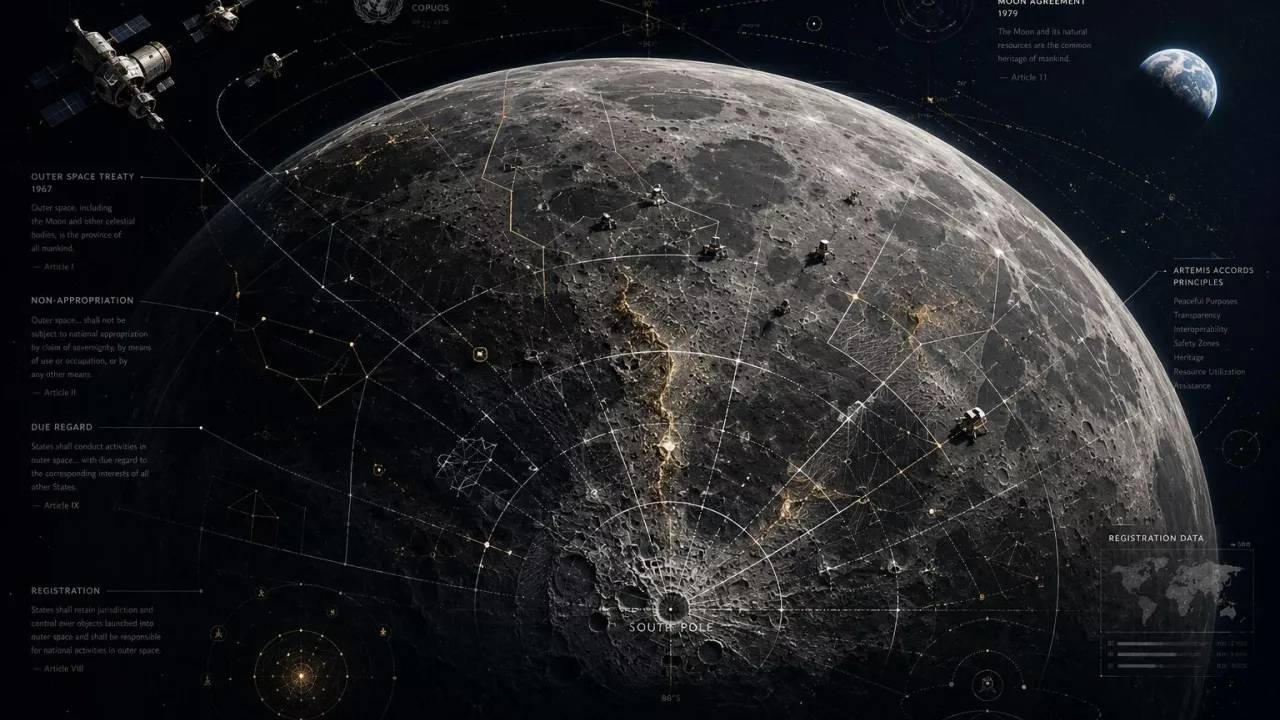
As humanity moves toward a resource-rich lunar economy, the greatest question may not be whether we can reach the Moon—but whether the benefits of reaching it will belong to everyone.
For most of human history, outer space existed beyond our practical reach. It was a realm to observe, calculate and imagine. That is changing rapidly. The Moon is becoming a destination for increasingly sophisticated missions, water ice is being investigated as a potentially valuable resource, governments are developing new rules for lunar activity, and private companies are preparing for a much more commercially active space environment.
At the same time, international diplomacy is confronting familiar problems in a new environment: militarization, unequal technological capabilities, environmental protection, competition over resources and questions about who gets to make the rules. Recent developments—from calls for a legally binding treaty to prevent an arms race in outer space to new lunar missions and debates within the United Nations system—may appear unrelated. Together, however, they point toward one fundamental question: will outer space become another frontier of competition and accumulation, or can humanity build a system in which its opportunities and resources are used for the benefit of all?
That question becomes increasingly urgent as humanity moves closer to extracting resources beyond Earth.
Peaceful Use of Outer Space Is Becoming a Security Question
Iran's recent call for negotiations toward a comprehensive, legally binding treaty to prevent an arms race in outer space reflects a longstanding concern within international diplomacy: the peaceful use of space cannot be separated from the security environment surrounding it.
The issue is larger than preventing weapons from being placed in orbit. A heavily militarized space environment can threaten satellites, communications, navigation, scientific missions and the long-term accessibility of space itself. It can also deepen an existing technological divide. Countries possessing advanced launch, surveillance and military-space capabilities have substantially greater influence over the future security architecture than countries that remain largely dependent on external systems. If space security is defined exclusively by those with the greatest capabilities, the principle of equal participation becomes difficult to sustain.
Preventing an arms race is therefore also a question of equitable access to peaceful space activity. A stable space environment benefits every country, but instability can impose disproportionate costs on those with fewer alternatives.
Outer Space as a Global Commons
The European Union's description of outer space as a "global commons" captures another dimension of the challenge. The concept emphasizes that the value of space does not belong exclusively to the countries and companies capable of reaching it first. Its stability, scientific knowledge, environmental conditions and long-term opportunities have consequences for humanity as a whole.
International law already provides an important foundation. The Outer Space Treaty establishes principles including the freedom of exploration and use of outer space, the prohibition of national appropriation of celestial bodies and the requirement that States conduct activities with appropriate regard for the interests of others.
But the legal architecture is being tested by technological change.
Voluntary commitments and norms of responsible behavior can reduce dangerous activities, including destructive anti-satellite testing. Yet as space becomes more commercial and strategically important, a difficult question emerges: how far can voluntary responsibility take humanity when enormous economic incentives are involved?
The answer may determine whether today's relatively open space environment remains open tomorrow.
The Most Important Question: Who Owns the Future Resources of Space?
Perhaps the most consequential question of the emerging space economy is deceptively simple:
Who gets to benefit from the resources of the Moon, asteroids and other celestial bodies?
The answer requires distinguishing several concepts that are often mixed together.
Owning a celestial body is not the same as extracting a resource from it. Establishing a mine is not necessarily the same as claiming the territory surrounding that mine. Using water extracted from lunar ice is different from claiming ownership of the Moon itself. And allowing commercial activity is different from determining who ultimately benefits from that activity.
The Outer Space Treaty provides a critical starting point through its non-appropriation principle: outer space, including the Moon and other celestial bodies, is not subject to national appropriation by sovereignty, use, occupation or other means. At the same time, the treaty does not provide a comprehensive operational regime for a future global economy based on extraterrestrial resources.
That gap has become one of the most important debates in modern space law.
The central legal question is whether resource extraction can be conducted consistently with the prohibition against appropriation of celestial territory. Some States and legal scholars argue that extracting and using resources can be compatible with the treaty so long as it does not amount to territorial sovereignty or appropriation. Others remain concerned that large-scale commercial extraction could create de facto control over strategically important areas and resources even without a formal declaration of ownership.
This is why the debate is not simply about mining.
It is about power, access and distribution.
Common Heritage of Humankind: From Principle to Justice
The phrase "common heritage of mankind" carries particular importance because it offers a different way of thinking about extraterrestrial resources.
The Outer Space Treaty describes outer space as the "province of all mankind." The Moon Agreement goes further by describing the Moon and its natural resources as the common heritage of mankind and envisioning an international regime for exploitation when such exploitation becomes feasible.
These formulations should not be treated as interchangeable. Nor should the Moon Agreement's approach be presented as universally accepted. Its participation is considerably narrower than that of the Outer Space Treaty, which has much broader international acceptance.
Nevertheless, the common-heritage concept raises a question that will not disappear simply because States disagree about the treaty framework:
If extraterrestrial resources become economically valuable, should their benefits belong exclusively to whoever has the technology to reach them first?
There is a powerful argument that they should not.
Common heritage does not necessarily have to mean that every lunar rock, asteroid or deposit is collectively owned by a single global institution. Nor does it necessarily require banning private companies from extracting resources. A more practical interpretation could mean that commercial activity is permitted within an international framework designed to ensure that the benefits of space development are not permanently concentrated among a handful of technologically advanced States and corporations.
That could include equitable benefit-sharing, opportunities for developing countries, technology and knowledge cooperation, scientific access, environmental safeguards and transparent international governance.
In this sense, common heritage is ultimately a question of justice.
What Would Benefit-Sharing Actually Mean?
Imagine that lunar water becomes commercially valuable.
A small number of companies possess the launch systems, spacecraft, robotics, communications networks and financial capital necessary to extract it. They establish operations around the lunar south pole and begin supplying water or derivatives to other lunar missions.
The economic logic is straightforward: those who invested should receive returns.
But there is another legitimate question.
What does humanity as a whole receive?
A meaningful common-heritage framework could seek an answer without eliminating private enterprise.
Benefits might include shared scientific data, international research opportunities, technology-development programs, educational initiatives, financial mechanisms supporting participation by developing States, and eventually some form of international benefit-sharing associated with commercially significant exploitation.
Such a system would recognize an important reality: the space economy will almost certainly require enormous private investment, but private investment and public benefit do not have to be opposing principles.
The challenge is designing institutions in which they reinforce one another.
The Risk of a Space Economy Designed After the Fact
There is another reason to establish principles early.
Once infrastructure, companies and economic interests become deeply established around valuable lunar resources, changing the rules becomes considerably harder.
A company that has invested billions in a particular region of the Moon will naturally resist regulations that substantially alter the economics of its operation. A State that has developed technological dominance in a particular resource sector may have little incentive to redistribute the resulting advantages.
This creates a familiar pattern from human history: those who arrive first can acquire disproportionate influence over the rules that follow.
Space offers humanity an opportunity to avoid repeating that pattern.
The international community does not need to prohibit exploration or commercial activity. It needs to ensure that the first generation of lunar economic activity does not quietly become the foundation for permanent exclusion.
Artemis Accords and COPUOS: Two Different Paths Forward
The growth of the Artemis Accords demonstrates one approach to the problem. The Accords provide participating countries with practical principles concerning lunar exploration, resource utilization, safety, heritage and cooperation, while reaffirming the framework of the Outer Space Treaty.
Supporters can reasonably argue that practical rules are needed now. Waiting for perfect universal consensus could leave operators without sufficient guidance as lunar missions accelerate.
Critics, however, raise an equally important concern: rules affecting humanity's shared extraterrestrial environment and resources should ideally emerge through processes in which all States can participate on an equal basis.
This tension explains the continuing importance of the United Nations Committee on the Peaceful Uses of Outer Space, or COPUOS.
COPUOS provides a multilateral forum in which States with dramatically different political systems, economic capabilities and levels of technological development can participate in discussions about the future of space. Its work on the legal aspects of space-resource activities therefore matters beyond the technical wording of any eventual principles. It is part of a larger struggle to determine who gets to shape the rules of the emerging space economy.
The Global South Cannot Be an Observer in the Space Economy
The increasing participation of countries from the Global South is therefore significant.
Saudi Arabia's election to a leadership position within COPUOS is one example of a broader reality: the future of space governance cannot credibly be described as universal if large parts of humanity have little influence over the decisions being made.
Representation, however, is only the beginning.
A genuinely inclusive space economy would require more than seats at diplomatic meetings. Countries that currently lack advanced space capabilities need opportunities to participate in scientific missions, access data, develop technical expertise, educate researchers, build infrastructure and participate economically.
Otherwise, humanity could create a paradox.
Space could legally belong to all humanity while the practical ability to benefit from it belongs to only a small fraction of humanity.
That would satisfy the language of universality while undermining its substance.
The Moon Is Not an Empty Mine
Chang'e-7's investigation of the lunar south pole illustrates why these questions are becoming increasingly concrete.
Permanently shadowed regions near the lunar poles are of extraordinary scientific interest because they may preserve water ice and other volatile materials. Water could eventually become important not only for scientific research but also for sustained human activity, potentially providing life-support resources and raw material for producing propellant.
That does not make scientific investigation equivalent to commercial exploitation. It does, however, demonstrate why lunar resource governance can no longer be dismissed as a distant theoretical problem.
The sequence may be simple:
exploration → mapping → prospecting → technology demonstration → extraction → commercial utilization.
Humanity is increasingly approaching the middle of that sequence.
The rules governing the later stages therefore need to be considered before the economic incentives become overwhelming.
The Moon Is Also an Environment
The uncontrolled lunar impact involving a discarded Falcon 9 upper stage offers another warning.
A single impact may have limited consequences in isolation. The larger issue is what happens when lunar activity becomes substantially denser.
Earth has learned the cost of treating the environment as an unlimited dumping ground. Orbital space is already experiencing the consequences of accumulated debris. The Moon could face a different but related challenge as landers, upper stages, vehicles, infrastructure and other objects increasingly interact with its surface and surrounding environment.
The Outer Space Treaty requires States to conduct activities with appropriate regard to the corresponding interests of other States and to avoid harmful contamination and adverse changes to the environment of Earth resulting from the introduction of extraterrestrial matter.
The practical interpretation of these principles will become increasingly important as lunar operations multiply.
Intergenerational Space Justice
Environmental protection in space introduces an idea that deserves far greater attention: intergenerational equity.
The Moon does not belong only to the generation that first develops the technology to exploit it.
Future generations may value the Moon for scientific reasons that we cannot yet anticipate. They may want to study pristine geological regions, investigate ancient lunar history, preserve landing sites, or develop technologies that make today's inaccessible resources economically important.
A decision made today can therefore remove options from people who do not yet exist.
That is the essence of intergenerational environmental justice.
The objective should not be to freeze the Moon in its current state. Exploration and responsible utilization are legitimate human activities. The objective should be to ensure that development does not unnecessarily destroy the scientific, environmental and cultural possibilities available to future generations.
The Moon Is Part of Humanity's Heritage
There is another dimension that economics alone cannot capture.
The first human landing sites, scientific instruments, historic spacecraft and other traces of humanity's earliest activities beyond Earth represent something larger than property.
They are evidence of a moment in human history when our species first began extending its physical presence beyond its home planet.
Future lunar governance therefore needs to recognize the Moon as both a potential resource environment and a historical record.
The question is not whether humanity should develop the Moon.
It is whether development can coexist with preservation.
A future Moon filled with infrastructure could represent extraordinary human achievement. But if every historically significant site is treated simply as an obstacle to industrial activity, humanity may discover too late that it has destroyed part of its own extraterrestrial heritage.
The Governance Gap Is Growing Faster Than the Space Economy
The central problem emerging from these developments is therefore not technological.
Humanity already possesses many of the technologies necessary to dramatically increase activity around the Moon.
The problem is governance.
Technology can move faster than diplomacy. Companies can make investment decisions faster than international organizations can negotiate treaties. Missions can be launched before States have agreed on comprehensive standards for their end-of-life disposal.
That creates a dangerous asymmetry.
The physical reality of the space economy can become established before the legal and ethical architecture governing it is complete.
If that happens, future international negotiations may not be deciding how space should be developed. They may simply be deciding how to manage an economic order that has already been created.
That is why the present moment matters.
Toward a Just Framework for Space Resources
No single institution currently provides a complete answer to the question of how humanity should govern extraterrestrial resources.
But several principles could provide a foundation for future international negotiations.
1. No appropriation of celestial territory
Resource extraction should never become a disguised mechanism for acquiring territorial sovereignty.
2. Benefit of all humankind
The development of space should produce benefits extending beyond the small group of States and corporations capable of reaching resources first.
3. Equitable participation
Developing countries should have meaningful opportunities to participate in scientific and economic space activity.
4. Transparency
Major resource activities should be appropriately registered and disclosed so that other States and the international community can understand what is taking place.
5. Environmental stewardship
Lunar and other celestial environments should be protected from unnecessary contamination, irreversible damage and irresponsible disposal.
6. Intergenerational equity
Today's decisions should preserve meaningful choices for future generations.
7. Protection of scientific and cultural heritage
Locations and objects of exceptional scientific or historical significance should receive appropriate protection.
8. Responsible commercial activity
Private companies should be able to contribute capital, technology and innovation, but commercial activity should operate within internationally recognized principles.
9. Peaceful use
Space security should not become a justification for excluding countries from peaceful exploration and utilization.
10. International benefit-sharing
Where extraterrestrial resources eventually generate substantial economic value, the international community should seriously consider mechanisms through which a portion of those benefits can contribute to humanity more broadly.
These should be understood as proposed principles for future governance, not as a statement of existing international law.
A Choice Larger Than the Moon
The debate over lunar resources is ultimately not only about the Moon.
It is about what kind of civilization humanity wants to become when its technological reach finally exceeds Earth.
For centuries, powerful societies expanded into new territories and frequently treated resources as prizes belonging to whoever could seize them. Space gives humanity the unusual opportunity to establish a different precedent before the frontier becomes economically mature.
The principle of common heritage offers one possible foundation.
It says, in essence, that humanity's relationship with extraterrestrial resources should not be determined solely by technological capability, military power or financial capital. It asks us to consider those who cannot yet reach the Moon, those who may contribute scientific knowledge rather than spacecraft, those in developing countries who seek a meaningful place in the future space economy, and generations that have not yet been born.
This does not require humanity to abandon commerce.
It requires humanity to govern commerce.
It does not require humanity to abandon exploration.
It requires humanity to make exploration sustainable and inclusive.
And it does not require humanity to prevent technological leaders from advancing.
It requires humanity to ensure that technological leadership does not become permanent ownership of humanity's future.
The Choice Before Humanity
Outer space is simultaneously becoming a security domain, a scientific laboratory, an environmental responsibility, a cultural heritage site and an emerging economic frontier.
Those dimensions cannot be governed independently.
Militarization affects peaceful access. Resource extraction affects environmental protection. Environmental decisions affect future generations. Commercial development affects equality. And the rules established by today's space powers will influence countries that have not yet launched their first spacecraft.
The most important question, therefore, is not simply:
How much can humanity extract from space?
It is:
How can humanity explore and use space without denying the rights, opportunities and interests of humanity as a whole?
The answer will not be found in one treaty, one country, one company or one mission.
It will be built through international law, diplomacy, scientific cooperation, responsible commercial activity and a willingness to recognize that the benefits of technological progress can be shared without preventing innovation.
Humanity has spent centuries learning how to divide the resources of Earth.
Perhaps the greater test is whether, before reaching deeply into space, we can learn how to share its future.
Space should not become merely another frontier to be conquered. It should become a test of whether the principles of peace, justice, sustainability and human dignity can extend beyond Earth.
And if extraterrestrial resources truly represent a new chapter in human civilization, then the first rule of that chapter should be simple:
The future of space must not belong only to those who arrive first. It must remain a future in which all humankind has a rightful place.
Frequently Asked Questions
What does "common heritage of humankind" mean in space law?
The concept is most explicitly associated with the Moon Agreement, which describes the Moon and its natural resources as the common heritage of mankind. It implies that their exploitation should be governed with the interests of humanity as a whole in mind. It should not automatically be equated with collective ownership of every extraterrestrial resource.
Does the Outer Space Treaty ban space-resource extraction?
The legal status of resource extraction under the Outer Space Treaty remains debated. The treaty clearly prohibits national appropriation of outer space and celestial bodies, while States differ in their interpretation of how resource extraction can be conducted consistently with that principle.
Is the Moon Agreement the same as the Outer Space Treaty?
No. They are separate international treaties. The Outer Space Treaty has much broader participation and establishes foundational principles for international space activity. The Moon Agreement contains additional provisions concerning the Moon and its resources, including its common-heritage formulation.
Could private companies mine resources on the Moon?
The possibility of commercial resource extraction is increasingly being considered by governments and industry. However, commercial activity does not eliminate international legal obligations. Questions concerning appropriation, jurisdiction, environmental protection, international responsibility and equitable governance remain important.
Why does benefit-sharing matter?
Without some form of benefit-sharing or equitable participation, the economic benefits of extraterrestrial resources could become highly concentrated among countries and companies possessing advanced space technology. Benefit-sharing is therefore one possible mechanism for connecting commercial space development with the broader principle that outer space should benefit humanity as a whole.