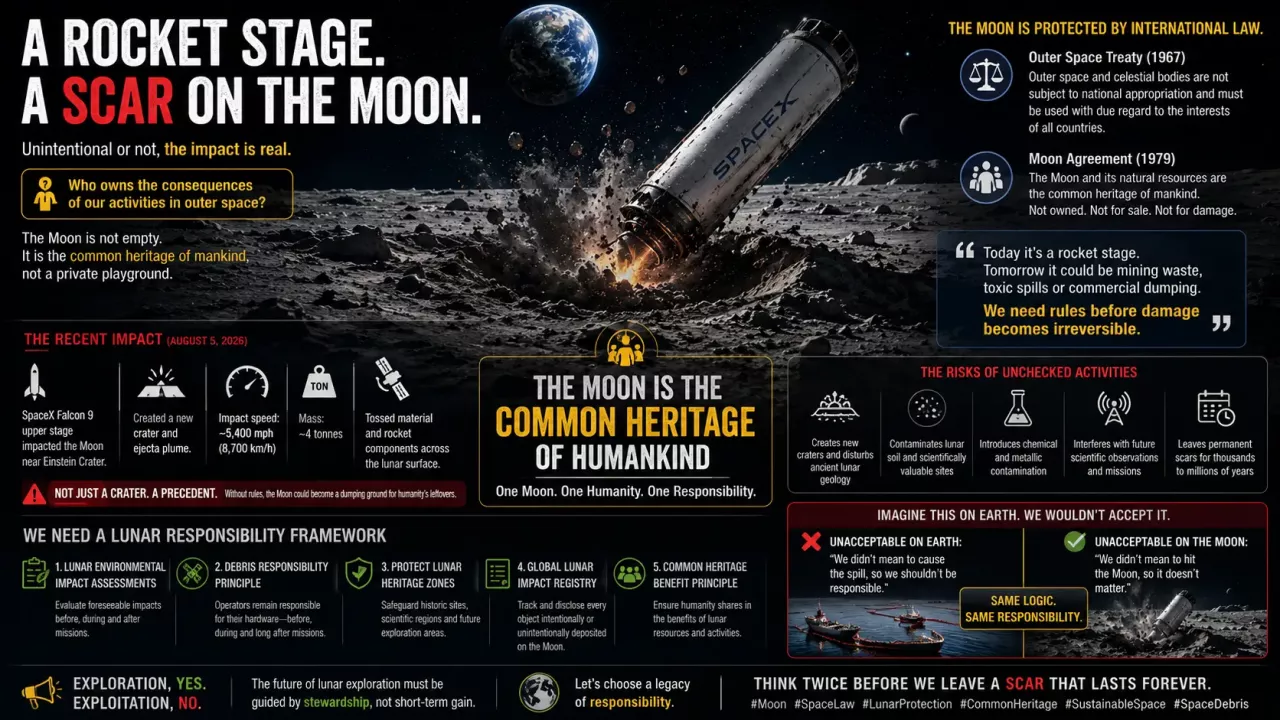
A 4-tonne piece of SpaceX Falcon 9 hardware has now left a permanent mark on the Moon.
They say it was not intentional science. It was simply the final trajectory of discarded human hardware that eventually intersected with the lunar surface. That distinction does not absolve anyone.
The deeper question is not technical. It is civilizational:
Who owns the consequences of our presence on a body that belongs to no one — and therefore to everyone?
Under the Outer Space Treaty, celestial bodies are not subject to national appropriation. The Moon Agreement goes further, declaring the Moon and its resources the common heritage of humankind. Yet private actors can still:
- send hardware toward the Moon,
- abandon stages in cislunar space,
- create artificial impact sites,
- disturb regolith and scientifically valuable zones,
- and alter an environment that is held in collective trusteeship.
The impact reportedly produced a new crater and ejecta plume. Scientists are studying the material thrown into the lunar environment. That should not be celebrated as an interesting side effect. It must trigger a governance reckoning.
There is no lunar environmental regulator. No mandatory impact assessment authority. No binding “leave no trace” standard. No mechanism that requires a commercial operator to answer to humanity for irreversible alteration of a shared inheritance.
Voluntary principles (Artemis Accords included) are not enough when activity is about to scale.
Imagine the same logic on Earth: “The tanker did not intend the spill, therefore the environmental cost does not count.” We would reject that instantly. Why should the Moon be treated as a free dumping ground?
What Must Happen Now
1. An international effort of real pressure is required. Not polite statements. Coordinated, transparent demand for full disclosure and accountability from SpaceX and every operator whose hardware ends on the lunar surface. We need independent analysis of what actually occurred, what materials were deposited, and what precedent has been set. Responsibility cannot remain optional.
2. We must examine whether “safety” language is being used to pre-claim operational zones. Every uncontrolled impact, every abandoned stage, every new crater can quietly become justification for exclusion zones, “safety perimeters,” or first-mover operational rights. That is how de facto workshops and exclusive footholds are secured under the cover of technical necessity. Stewardship demands we name this pattern before it hardens into practice.
The Framework We Actually Need
Before large-scale mining, construction, or settlement begins, humanity requires:
- Mandatory Lunar Environmental Impact Assessments for any mission that can foreseeably disturb soil, permanently shadowed regions, or future exploration sites.
- A binding Debris Responsibility Principle: operators remain accountable for stages and spacecraft after the mission ends.
- Protected Lunar Heritage and Scientific Zones with real force, not voluntary guidelines.
- A Global Lunar Impact Registry — every artificial object deposited, intentional or not.
- A Common-Heritage Benefit Principle: if lunar resources generate private wealth, a meaningful share returns to humanity as a whole through transparent, intergenerational mechanisms.
This is not anti-exploration. Exploration is a duty of stewardship. It is anti-externalization of cost onto a body held in collective trusteeship.
The first footprints were symbols of human reach. The next generation must decide whether our lasting mark will be exploration under Cosmic Equity and Collective Trusteeship — or extraction, debris, and irreversible scars justified by “it wasn’t intentional.”
The Moon is not empty. It is a shared inheritance held in trust. We do not have permission to treat it as a dumping ground.
We need stewards, not spectators. We need pressure that produces accountability, not press releases. And we need governance structures that make the moral claim of the Outer Space Treaty operational — before the next scar is normalized as progress.
The Cosmic Trust is not a slogan. It is the standard we either enforce now, or lose.